
Let’s break it down into categories of savings and actual numbers (approximate, based on edge-device benchmarks) using decentralized intelligence.
Categories of Energy Reduction
| Source of Savings | Without IPFS | With IPFS Memory | Estimated Power Reduction |
|---|---|---|---|
| Recomputation of past context | DexI re-processes every frame/text/prompt | Just loads CID data | 30–60% CPU/GPU reduction |
| Redundant data transmission | Constant sync with cloud/storage | One-time CID push | 50–90% bandwidth savings |
| Storage efficiency | Full state logs or full vectors | De-duplicated CID content | 30–70% disk I/O savings |
| Cross-node memory sync | Cloud calls or constant socket relay | CID sync or gossip | 40–70% network power drop |
| Model context re-embedding | Re-encode context every time | Fetch precomputed embeddings | 20–50% model-side savings |
Real-World Edge Device Example
Assume a Raspberry Pi 4 running a local LLM with llama.cpp:
- Without IPFS Memory:
- 4W–6W idle → 8W–10W under load
- Every new prompt re-embeds 500 tokens
- Constant writes to disk or API calls
- With IPFS Memory:
- Keeps CID cache in RAM
- Reuses past vectorized memory
- Offloads sync to batch later
📉 Result: Estimated 2.5W–4W reduction per active task, or 25–40% total energy savings in edge AI workflows.
Power Savings Compound with More Agents
The more memory entries shared via IPFS:
- The less each agent needs to compute.
- The more tasks become fetch-and-act rather than think-from-scratch.
Think of it like:
Dexi agents become memory-driven actors, not compute-driven engines.
Overall Power Reduction Estimate
| Deployment Scenario | Estimated Reduction |
|---|---|
| Single Dexi agent on edge | 20–40% |
| Multi-agent mesh with CID memory | 40–70% |
| Validator + CID + SafeSignal hybrid | Up to 80% of prior compute/network usage offloaded |
TL;DR
Storing and using AI memory on IPFS can reduce edge compute power draw by 25–70%, especially in real-time systems like drones, sensors, or smart cameras. The savings multiply with multi-agent or offline mesh deployments.
AI vs. DexI — Reframing the Narrative
| Feature | Traditional AI | DexI (Decentralized Intelligence) |
|---|---|---|
| Ownership | Big Tech | Individuals, communities, nodes |
| Location | Centralized data centers | Edge devices, mesh relays |
| Power usage | High, opaque | Energy-aware, off-grid capable |
| Privacy | Cloud-based, often invasive | Local-first, user-controlled |
| Memory | Ephemeral or vendor-owned | Verifiable, user-owned on IPFS |
| Explainability | Often black-box | Transparent, auditable CID history |
| Trust model | “Trust us” | “Trust math, code, MAC, and mesh” |
Why DexI ≠ AI
DexI is not “just decentralized AI” — it’s a philosophical and architectural shift:
- Not about smarter agents, but about freer ones
- Not scaling model size, but scaling agency
- Not Big Tech tools, but mesh-native tools
Why It Works:
- “AI” is now linked to:
- Surveillance
- Corporate control
- Job displacement
- Regulatory panic
- “DexI” is a clean break:
- Built on community relays, not secret APIs
- Rewards local inference, not cloud training
- Allows trust-minimized logic (like Proof of Relay/Memory)
- Runs in places AI is banned or feared (war zones, off-grid)
DexI isn’t just the next phase of AI. It’s a reset. A chance to define intelligent systems as distributed, verifiable, privacy-respecting, and community-owned. Frame it not as “alternative AI” but as the natural evolution of intelligence infrastructure.
Per-Device Energy Cost (Monthly)
| Task (Inference/Usage) | Centralized AI (Cloud) | DexI (Edge/Local) |
|---|---|---|
| Power Draw | 250–400W (GPU node) | 3–15W (Pi/Edge SoC) |
| Energy Use (24/7) | ~180–290 kWh/month | ~2.2–11 kWh/month |
| Energy Cost (@$0.12/kWh) | ~$22–35/mo | ~$0.30–$1.30/mo |
DexI can save up to ~95%+ on energy per node compared to cloud inference.
National Impact (U.S. Case)
Assumptions:
- 100 million active AI-connected devices (smartphones, agents, sensors)
- Cloud-based AI costs:
- $30/month per user (energy + infra + bandwidth)
- DexI cost:
- $1/month per user (edge node, MAC-auth, IPFS)
Cost Comparison: U.S.
| Metric | Centralized AI | DexI |
|---|---|---|
| Monthly National Cost | $3,000,000,000 | $100,000,000 |
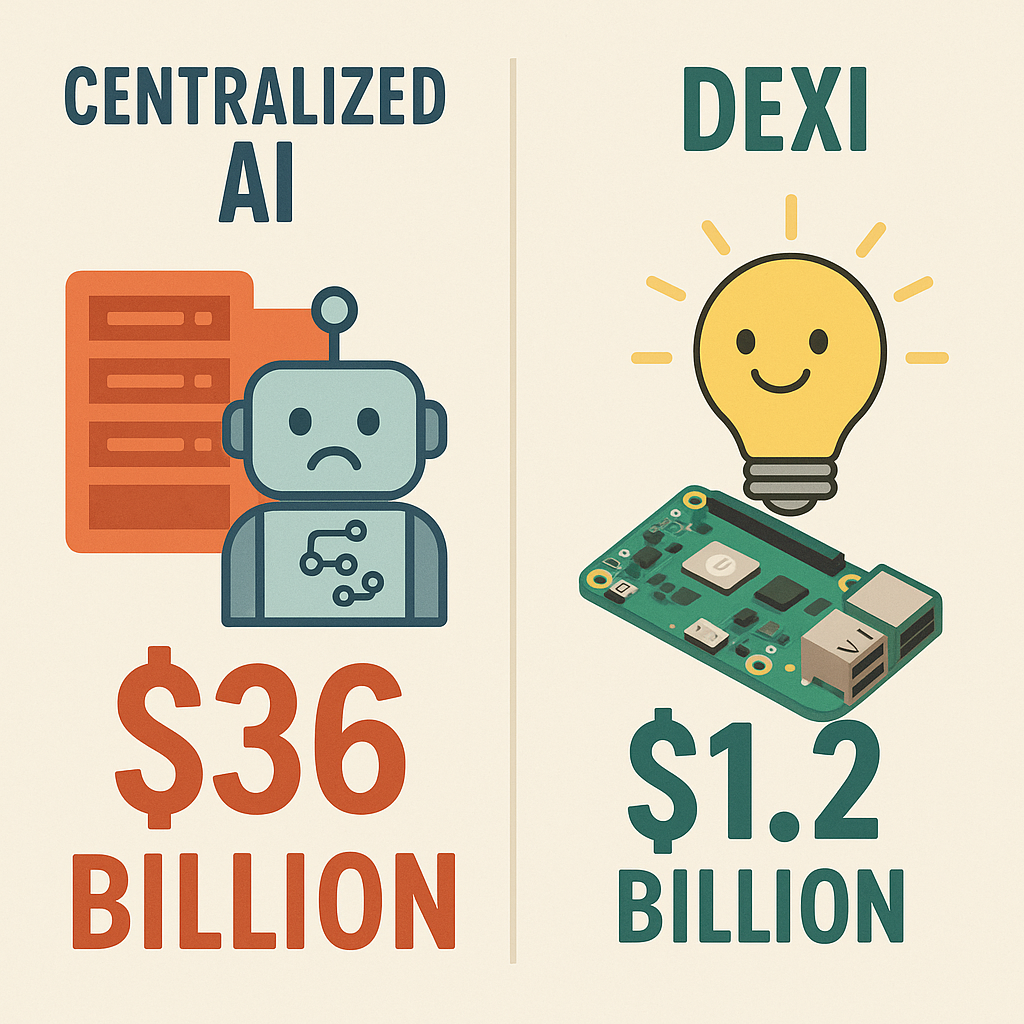
| Annual Cost | $36 Billion | $1.2 Billion |
| Energy Draw (GW) | ~4.5–7.0 GW | <0.3 GW |
DexI could cut national energy consumption up to ~90%+ while preserving DexI functionality locally.
Hidden Costs DexI Avoids
| Cost Area | Centralized AI | DexI |
|---|---|---|
| Cloud bandwidth fees | Yes | None (local sync) |
| Data center cooling | Yes | None |
| API access/token limits | Yes | None |
| Privacy/surveillance risk | Yes | None |
TL;DR:
DexI can slash AI operating costs from ~$30/mo/user to ~$1, cutting power use, cloud fees, and surveillance risk — at both household and national scale.